
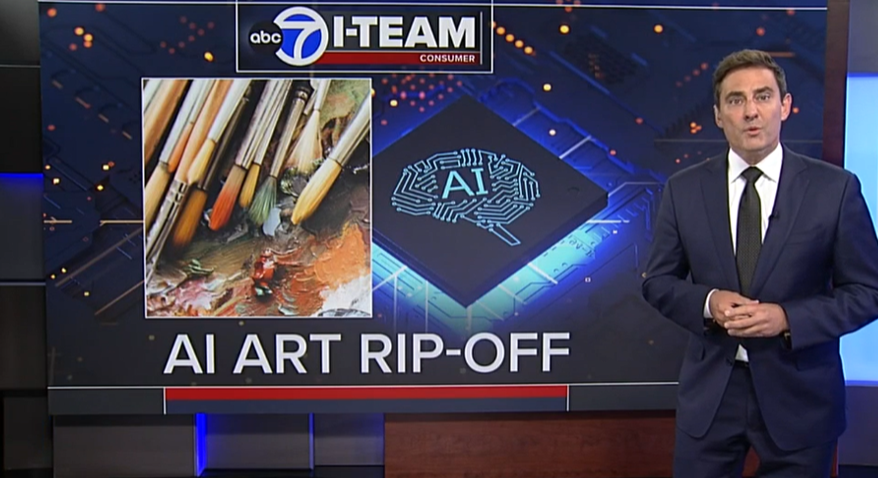
Wheaton, Illinois, illustrator Jason Seiler recently discovered an AI-generated caricature that not only mimicked his distinctive style but even included his signature.
Seiler, well-known for caricatures in major publications worldwide, expressed outrage: “It takes away from all the years that I’ve worked, it’s my livelihood.”
For Seiler, the discovery raises broader concerns about how generative AI tools can imitate and distribute an artist’s work in seconds, undermining both personal integrity and professional income.
Legal Challenges and Copyright Concerns The legal landscape for protecting artists like Seiler is murky. Experts explain that copyright infringement cases are difficult to prove when it comes to AI. Claimants must identify the specific AI system and the user responsible for the prompt. Suing the AI companies themselves is more complex, since their outputs are often protected under “fair use.”
Another issue lies in the copyrightability of style itself. U.S. law does not recognize artistic “style” as protectable in the same way as a specific work. Several lawsuits currently underway in California may begin to set precedents on whether AI-generated imitations qualify as infringement.
Echoes in the Music World: Lawsuits, Licensing, and the Fight for Artistic Rights
1. Music Labels vs. AI: Suno and Udio in the Crosshairs. The Recording Industry Association of America (RIAA), supported by Universal, Sony, and Warner, filed lawsuits in 2024 against AI music startups Suno and Udio. The claim is that these platforms trained their AI models on copyrighted sound recordings without authorization. The lawsuits seek injunctions and damages up to $150,000 per infringed work. In 2025, country artist Tony Justice and other independent artists launched class-action suits against both companies, alleging that their songs were “scraped and duplicated” to train AI without their permission.
Suno maintains that its platform generates original works and does not sample existing recordings.
2. Negotiations with Labels Despite the Lawsuits: Major record labels are simultaneously exploring licensing deals with Suno and Udio. These talks include potential systems for attribution, compensation, and opt-out provisions. The aim is to build a framework similar to YouTube’s Content ID that balances innovation with artist rights.
3. Industry Adoption with Guardrails: Not all developments are adversarial. AI-assisted artist imoliver, one of the most-streamed creators on Suno, signed a record deal with Hallwood Media in 2025. This shows AI tools can augment careers rather than replace them. At the same time, streaming service Deezer introduced AI song tags and anti-fraud tools, flagging AI-generated tracks and blocking bot-driven royalty scams.
4. Beyond Music and Art: Copyright Disputes Across Industries, Authors vs. AI Models: Writers, including Andrea Bartz and Charles Graeber, sued Anthropic for using their books in model training. A judge ruled parts of the use as fair use, although unresolved claims are set for settlement in September 2025.
Media vs. AI Platforms: Japanese publishers Nikkei and Asahi Shimbun sued AI search startup Perplexity for distributing their articles without permission and stripping copyright metadata.
DMCA and Attribution Cases: U.S. courts are testing whether AI platforms violate the Digital Millennium Copyright Act by removing or failing to provide attribution, as seen in suits involving The New York Times, Intercept Media, and others.
What does this mean for the Creative Economy? Artists’ livelihoods and creators face economic threats from rapid, low-barrier replication.
Legal complexity – Identifying responsible parties in AI cases remains difficult.
Fair use ambiguity – Courts remain split on whether training data use is protected.
Licensing models – Negotiations point toward frameworks that compensate artists fairly.
Transparency – Tagging, fingerprinting, and attribution systems may be critical safeguards.
Public perception – While some creators embrace AI as a tool, others fear displacement.
Final Thoughts From caricatures to chart-topping songs, the creative industries are entering uncharted territory. Jason Seiler’s experience is one story in a growing wave of disputes that will shape the boundaries of ownership, authorship, and originality in the age of generative AI. As lawsuits evolve and licensing frameworks emerge, the challenge for business leaders, artists, and policymakers is to ensure that technological innovation does not come at the cost of creative integrity.
Sources: ABC7 Chicago – Wheaton illustrator Jason Seiler says AI art piece ripped off his style – RIAA – Record companies bring landmark cases for responsible AI against Suno and Udio – Investopedia – Major Labels in Talks to License AI Use of Music – Wikipedia – Artificial Intelligence and Copyright – Mass Lawyers Weekly – Independent artists sue Suno AI copyright infringement – Music Business Worldwide – Suno argues none of its tracks contain samples – Wall Street Journal – Universal, Warner and Sony Negotiating AI Licensing Rights – MusicRadar – AI creator signs record deal with Hallwood Media – AP News – Deezer adds AI song tags in fight against fraud – Wired – Anthropic settles copyright lawsuit with authors – Financial Times – Nikkei and Asahi sue Perplexity over AI use of news articles – Reuters – How courts are handling DMCA calls against generative AI