
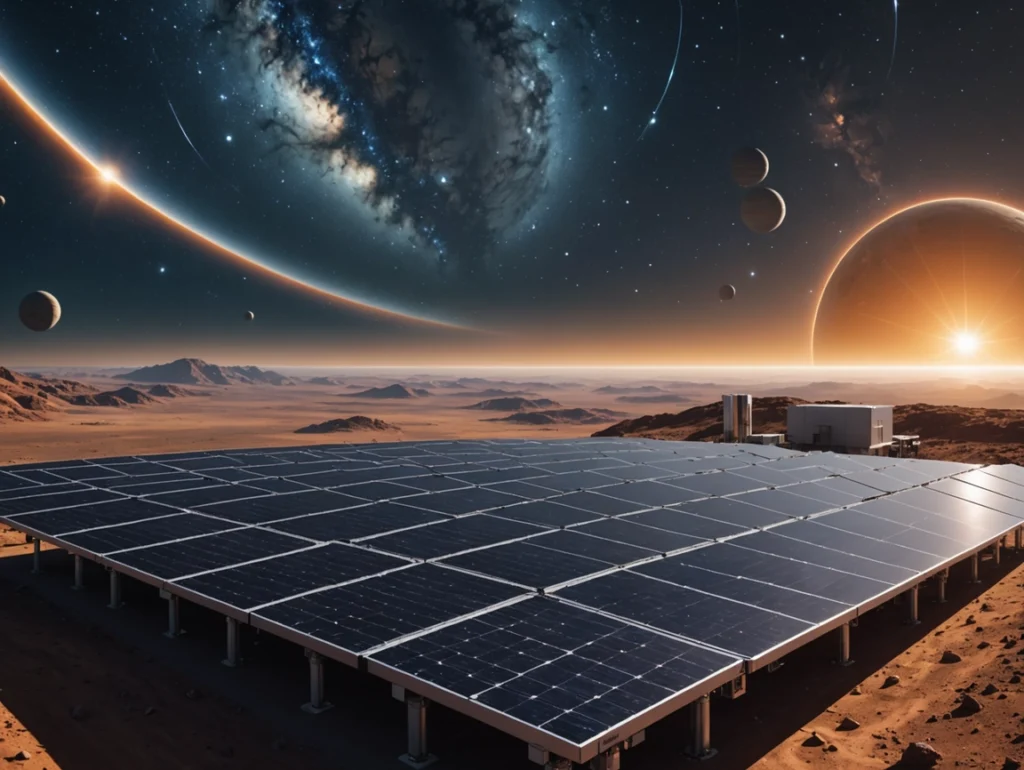
The Math Actually Works.
Project Suncatcher promises solar-powered data centers orbiting Earth by 2027. Here’s why your business should care.
The Problem Crushing Your AI Budget
Your data center costs double every year. Your AI training runs up millions in electricity bills. Your cooling bills rival your payroll.
Google faces the same problem. Their solution? Move the servers 400 miles up.
This week, Google revealed Project Suncatcher. It’s not science fiction. It’s a business plan with test satellites launching in 2027.
The numbers make executives pay attention. Space receives 8 times as much solar power as Earth. Cooling is free. Water usage drops to zero.
What Google Actually Proposed
Project Suncatcher puts AI chips on satellites. Not massive space stations. Small satellites flying in tight formation.
Each satellite carries Google’s TPU chips. They orbit where the sun never sets. Solar panels work 24/7. No batteries needed.
The satellites talk to each other using lasers. Speed: 1.6 terabits per second. That matches Earth data centers.
Google partnered with Planet Labs. Two test satellites will launch by early 2027. Full deployment could start by 2030.
The Business Case Is Real
Energy Costs Drop 90%
Earth data centers need power plants. Space data centers need solar panels.
On Earth:
- Coal plants cost $0.12 per kWh
- Natural gas costs $0.08 per kWh
- Solar with batteries costs $0.05 per kWh
In space:
- Solar power costs $0.01 per kWh (projected by 2035)
- No transmission losses
- No grid connection fees
- No peak pricing
Google’s analysis shows space power becomes cheaper than Earth power when launch costs hit $200 per kilogram. SpaceX already targets $100.
Cooling Costs Vanish
Your data centers burn water. Literally.
Earth data center water usage:
- 300,000 gallons per day for a typical facility
- 5 million gallons per day for large AI centers
- Google’s Iowa facility: 1 billion gallons in 2024
Space data center water usage:
- Zero gallons
- Heat radiates directly to space
- No cooling towers needed
- No water rights battles
The cooling math alone saves $10 million annually per facility. In drought zones, permits become impossible anyway.
Land Costs Disappear
Northern Virginia data centers cost $400 per square foot to build. Phoenix facilities cost $350. Silicon Valley hits $600.
Space costs nothing per square foot. You pay for the launch but the real estate is free.
The Problems Google Must Solve
Space Junk Could Kill Everything
Low Earth orbit contains 100 million pieces of debris larger than 1mm. A paint fleck traveling 17,000 mph destroys chips.
Satellites flying hundreds of meters apart multiply the collision risk. Current constellations of junk maintain a 120-kilometer separation between satellites. Google needs 0.5 kilometers.
One collision creates thousands more pieces. The cascade could end the entire project.
Mitigation costs:
- Debris tracking systems: $2 million per year
- Collision avoidance fuel: $500,000 per satellite
- Armored shielding: 20% weight penalty
- Insurance: 15% of launch costs
Solar Flares Fry Electronics
The sun attacks without warning. Solar flares hit in eight minutes. Coronal mass ejections arrive in two days.
Damage from one major flare:
- Memory corruption in 30% of chips
- Power system failures
- Communication blackouts for 48 hours
- Shortened satellite lifespan by 2-3 years
The 1859 Carrington Event would destroy every unshielded satellite today. Cost: $2 trillion globally.
Google tested their TPUs under radiation bombardment. They survived five years’ worth. But real space differs from lab tests.
You Can’t Fix Broken Hardware
Server fails on Earth? Tech arrives in an hour. Server fails in space? It’s dead forever.
Failure rates in space:
- 5% annual electronics failure (Earth: 2%)
- 10% solar panel degradation per year
- 15% chance of major failure in five years
Redundancy costs triple. Every critical system needs two backups. Weight increases by 300%. Launch costs follow.
Launch Costs Still Hurt
SpaceX charges $3,000 per kilogram today. Google needs it under $200 to break even.
Per-satellite costs (2025):
- Hardware: $5 million
- Launch: $15 million
- Insurance: $3 million
- Ground stations: $2 million
- Total: $25 million per satellite
A 100-satellite constellation costs $2.5 billion. That builds five Earth data centers.
Who Else Is Trying
Starcloud launches an Nvidia H100 GPU satellite this month. They claim all data centers will move to space within 10 years.
China deployed 12 computing satellites in May. Plans call for 2,800 total.
Europe’s ASCEND project studies feasibility. France’s Thales Alenia Space leads development.
Microsoft has remained quiet but filed seven space computing patents in 2024.
The Timeline That Matters
Next 6 Months
- Starcloud launches test satellite
- Google finalizes Planet Labs partnership
- First radiation testing results published
Next 2 Years (2027)
- Google’s test satellites launch
- Real orbital data replaces projections
- First customer pilots begin
Next 5 Years (2030)
- Launch costs drop below $500/kg
- The first commercial space data center operates
- Early adopters claim a competitive advantage
Next 10 Years (2035)
- Space data centers hit cost parity with Earth
- Water scarcity makes Earth facilities impossible
- Late adopters scramble for orbital slots
What This Means for Your Business
If You Run Data Centers
Start planning orbital strategy now. Even if you never launch, the threat changes everything. Investors will ask why you’re building on Earth when space costs less.
Lock in water rights immediately. Space competition makes Earth’s water more valuable. Cities will first restrict data center water use.
Partner or perish. Only Google, Amazon, and Microsoft can afford solo space programs. Everyone else needs alliances.
If You Buy Cloud Services
Demand transparency on infrastructure. Space-based processing has different latency, reliability, and security profiles. Know where your data lives.
Negotiate Earth-based guarantees. Some workloads can’t tolerate space risks, so you’d better secure terrestrial capacity before it becomes premium-priced.
Watch for new vendors. Space-native providers will emerge. They’ll offer different pricing models. Early contracts could lock in advantages.
If You Compete with Big Tech
This is your warning. Google isn’t experimenting. They’re building infrastructure that competitors can’t match.
Find your advantage. Maybe it’s edge computing. Perhaps it’s specialized chips. But “cheaper servers” won’t work when Google’s servers orbit Earth.
Consider the counterplay. Regulations could ban space data centers. Security concerns could limit adoption. Position accordingly.
The Bottom Line Math
Traditional AI data center (2025):
- Construction: $1 billion
- Annual electricity: $100 million
- Annual cooling water: $10 million
- Annual operations: $50 million
- Five-year total: $1.8 billion
Space AI data center (2030 projected):
- Satellites and launch: $2.5 billion
- Annual operations: $20 million
- Annual ground stations: $10 million
- No water costs
- Five-year total: $2.65 billion
Space AI data center (2035 projected):
- Satellites and launch: $500 million
- Annual operations: $20 million
- Five-year total: $600 million
By 2035, space costs 66% less than Earth. If you’re building data centers with 10-year horizons, the math already favors orbit.
Three Actions for This Week
First: Calculate your actual cooling costs. Include water, electricity, and equipment. Add drought risk premiums.
Second: Model your workloads for space compatibility. Batch processing works. Real-time trading doesn’t.
Third: Start the conversation with your board. They’ll hear about this from competitors soon.
The Real Question
It’s not whether space data centers are crazy. Everything about AI seemed crazy five years ago.
The question is timing. Google says 2027 for tests, 2030 for production.
History says first movers in infrastructure win for decades. Railroad barons. Telephone companies. Cloud providers.
Space might be next. Or it might be a $2.5 billion crater.
But one thing is sure: Your competitors are doing the math right now.
What’s your plan?
Based on Google’s Project Suncatcher announcement and technical paper published in November 2025. Launch timelines and cost projections from company statements and industry analysis.